
Reading a Yarn Ball Band: Every Symbol Explained
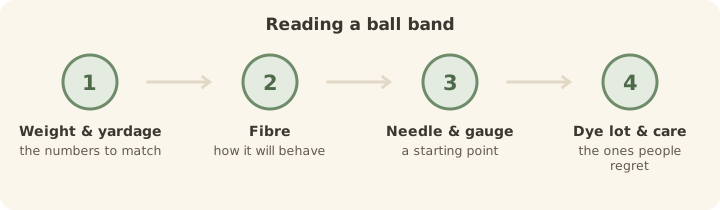
A ball band tells you the weight, yardage, fibre, recommended needle and hook, gauge, dye lot and washing instructions. The two that matter most when substituting are yardage and dye lot.
Keep the band — or write the details on a tag — the moment you open the ball.
What each part means
| On the band | What it means | Why it matters |
|---|---|---|
| Weight, e.g. 100 g | How much yarn is in the ball | Combined with yardage, lets you weigh part-balls later |
| Yardage or metres | How long the strand is | The number to match when substituting yarn |
| Fibre percentages | What it's made of | Decides washing, drape and whether it blocks |
| Needle symbol | Suggested needle size | A starting point for swatching, not a rule |
| Gauge square | Stitches and rows over 4 in / 10 cm | Tells you the weight class at a glance |
| Dye lot number | Which dyeing batch it came from | Different lots can differ visibly in daylight |
| Care symbols | Washing, drying, ironing | Determines whether a gift survives its first wash |
Band long gone?
Our yarn identifier works out the weight from a wraps-per-inch count, and gives typical yardage per 100 g for each weight so you can estimate what's left.
The care symbols
A tub with a hand means hand wash only. A tub with a number is the maximum machine temperature. A crossed-out tub means dry clean or spot clean only. A square with a circle is tumble drying — crossed out means don't. A triangle covers bleaching, and an iron symbol with dots shows the maximum heat, one dot being coolest.
Dye lot is the one people ignore and regret. Two balls of the identical shade from different lots can show as a faint band across a finished blanket — invisible in the shop, obvious in daylight at home. Buy all your yarn at once, and check the lot numbers match before leaving.
What the band doesn't tell you
It won't tell you how the yarn behaves — whether it splits, softens after washing, pills, or blooms into a halo. Only a swatch tells you that, and it's another argument for swatching before committing to a large project.
Keeping the information
Tie the band to the remaining yarn, or write the weight, yardage and washing details on a paper tag. When you finish a garment, tuck the band and the leftover yarn in with it — you then have the mending yarn and the washing instructions in the same place, which is exactly where you'll want them in three years.
Questions we're often asked
What is a dye lot?
The batch a yarn was dyed in. The same colour from two different lots can vary just enough to show as a stripe in a finished piece, so buy all you need at once.
Do I have to use the needle size on the ball band?
No — it's a starting suggestion. Your pattern's gauge is what matters, and many knitters go a size up or down from the band to achieve it.
How do I know how much yarn is left in a part-ball?
Weigh it. Divide the grams by 100 and multiply by the yards-per-100 g figure from the band. 45 g of a 220 yd per 100 g yarn holds about 99 yards.