
Understanding wire gauge
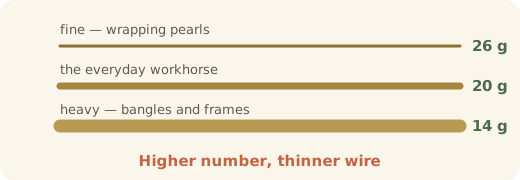
Wire gauge runs backwards, which trips up everyone at first: the higher the number, the thinner the wire. A 28 gauge wire is fine enough to thread through a small seed bead several times; a 12 gauge is a substantial rod you'll need proper cutters for. It helps to think of the number as "how many times it was drawn thinner", because that's essentially what it once meant.
AWG or SWG? Most jewellery wire, especially from American suppliers, is sold in American Wire Gauge. British and older suppliers sometimes use Standard Wire Gauge, and the two don't match — 18 AWG is 1.02 mm while 18 SWG is 1.22 mm. If a supplier quotes millimetres, trust the millimetres.
Which gauge for which job
- 28–26 gauge — very fine. Wire crochet, wrapping small beads, delicate weaving. Snaps easily if worked hard.
- 24–22 gauge — the everyday wrapping wires. Perfect for bead loops, small wrapped links and lighter chain maille.
- 20 gauge — the general workhorse. Strong enough for headpins and clasps, still soft enough to shape by hand.
- 18 gauge — sturdy. Ear wires, jump rings, clasps, frames and anything that must hold its shape.
- 16–14 gauge — heavy. Bangles, structural frames, bold statement pieces. You'll want good flush cutters.
- 12 gauge and thicker — properly substantial. Cuff bracelets and armatures; usually shaped with a hammer and mandrel.
Hard, half-hard and dead soft
Gauge tells you the thickness; temper tells you how it behaves. Dead soft bends easily and is lovely for curves and wrapping, but won't hold a shape under stress. Half hard keeps its form and is the usual choice for ear wires and clasps. Full hard is springy and stiff — good for jump rings that must not pull open. Work-hardening happens naturally as you bend and hammer wire, so dead soft becomes half hard as you work it.
Matching wire to bead holes
The commonest frustration in beading is wire that won't go through the bead. Most standard glass and gemstone beads have holes around 0.8 to 1 mm, which takes 20 gauge comfortably and 18 gauge only just. Pearls and many semi-precious stones are drilled much finer at 0.3 to 0.5 mm, needing 26 or 28 gauge. If you know your bead size but not the hole, our bead sizer will at least tell you what you're working with.
Jump rings
Jump ring strength depends on both gauge and diameter. An 18 gauge ring of 5 mm will hold a heavy pendant securely; a 22 gauge ring of the same size may pull open under weight. As a rule, use the heaviest gauge that suits the look, and always close rings by twisting the ends past each other sideways rather than pulling them apart — that keeps the round shape.
Questions we're often asked
How do I tell what gauge my wire is?
Measure its thickness. Lay a straight length against the calibrated bars above and find the one it matches, or measure with callipers and compare the millimetre reading to the chart. Remember that gauge numbers get larger as the wire gets thinner.
What gauge wire is best for jewellery making?
20 gauge is the most versatile starting point — strong enough for clasps and headpins, soft enough to shape by hand. Add 24 gauge for wrapping beads and 18 gauge for ear wires and jump rings, and you can make most things.
Is 18 gauge thicker than 20 gauge?
Yes. Wire gauge runs in reverse, so a lower number means thicker wire. 18 gauge is 1.02 mm and 20 gauge is 0.81 mm.
What wire gauge fits through a standard bead?
Most standard beads have holes of around 0.8 to 1 mm, which suits 20 gauge easily. Pearls and finely drilled gemstones need 26 or 28 gauge. When in doubt, go finer — you can always double the wire.
Are AWG and SWG the same?
No. They are different systems and the same number means different thicknesses — 18 AWG is 1.02 mm while 18 SWG is 1.22 mm. The chart above shows both, so you can convert between suppliers.