
Wire Gauge for Jewellery Making: Which Thickness for What
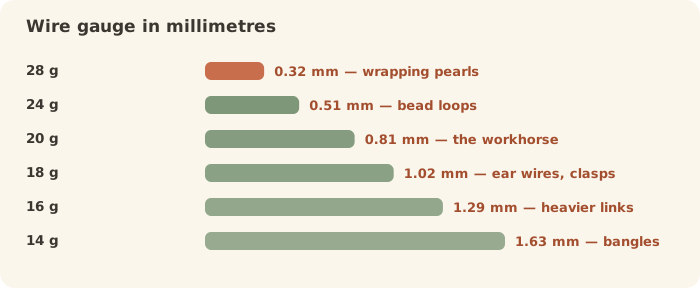
The first thing to know about wire gauge is that it runs the wrong way round. A 28 gauge wire is fine enough to thread through a pearl several times; a 12 gauge is a substantial rod that needs proper cutters. Higher number, thinner wire — always.
Why backwards?
The number once described how many times the wire had been drawn through progressively smaller dies to thin it. More passes meant thinner wire and a higher number. The manufacturing has changed; the numbering never did.
Identify an unlabelled coil
Wire spools lose their labels almost immediately. Our wire gauge identifier lets you lay a strand against true-size bars on your screen and read the gauge in AWG, British SWG, millimetres and inches.
Which gauge for which job
- 28 and 26 gauge — very fine. Wire crochet, wrapping small or finely drilled beads, delicate weaving. Snaps if worked too hard.
- 24 and 22 gauge — the everyday wrapping wires. Bead loops, small wrapped links, lighter chain maille.
- 20 gauge — the workhorse. Headpins, clasps, general shaping. If you buy one spool to start, buy this.
- 18 gauge — sturdy. Ear wires, jump rings, frames and anything that must keep its shape under weight.
- 16 and 14 gauge — heavy. Bangles, structural frames, bold statement pieces.
- 12 gauge and thicker — cuffs and armatures, usually shaped over a mandrel with a hammer.
Temper: the other half of the story
Gauge tells you thickness; temper tells you behaviour, and beginners often blame one for the other. Dead soft bends readily and is lovely for curves and wrapping, but won't hold its shape under stress. Half hard keeps its form and is the usual choice for ear wires and clasps. Full hard is springy and stiff — good where a jump ring must not pull open.
Wire also work-hardens as you handle it: every bend and hammer blow stiffens it a little. That's useful — you can shape dead soft wire and then harden it by tapping gently with a rawhide mallet — but it also means over-worked wire eventually becomes brittle and snaps. If a piece is fighting you, put it down rather than bending it once more.
Match your wire to the bead hole, not the other way round. Most standard glass and gemstone beads have holes of 0.8 to 1 mm, which takes 20 gauge comfortably and 18 gauge only just. Pearls and finely drilled stones need 26 or 28 gauge. Buying beautiful beads you cannot thread is a rite of passage nobody enjoys.
AWG or SWG?
American Wire Gauge is what most jewellery wire is sold as. British Standard Wire Gauge is a different system with the same-looking numbers, which is exactly as unhelpful as it sounds: 18 AWG is 1.02 mm while 18 SWG is 1.22 mm. When a supplier gives millimetres alongside the gauge, trust the millimetres.
Jump rings and strength
A jump ring's strength depends on both its gauge and its diameter. An 18 gauge ring of 5 mm will happily hold a heavy pendant; a 22 gauge ring of the same size may quietly pull open in a handbag. Use the heaviest gauge the design allows, and always close rings by twisting the ends past one another sideways rather than pulling them apart — pulling ruins the round shape and leaves a gap that never quite closes.
A sensible starter set
You need far less than the suppliers suggest. Spools of 24, 20 and 18 gauge in a colour you like will cover the great majority of projects, along with flush cutters, round-nose pliers and chain-nose pliers. Add finer or heavier gauges as specific projects demand them, rather than buying a rainbow of spools that sit unused.