
How to Substitute Yarn in Any Pattern
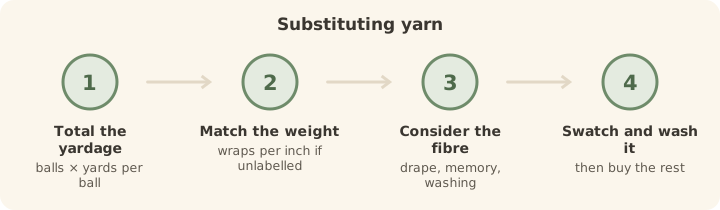
The yarn in the pattern is discontinued, or costs more than you'd like, or simply isn't stocked anywhere near you. Substituting is one of the most useful skills a knitter or crocheter can have, and it comes down to three checks: yardage, weight and fibre.
Check one: buy yardage, not balls
This is where most substitutions go wrong. Two yarns of the same weight can differ enormously in how much is on the ball — one might give 120 yards per 100 grams and another 240. Buying "ten balls" because the pattern says ten balls can leave you half a sleeve short.
Instead, multiply the pattern's ball count by its yardage per ball to get the total, then divide by your yarn's yardage per ball and round up. Ten balls at 120 yards is 1,200 yards; your yarn at 220 yards per ball needs six balls.
Let us do the arithmetic
Our yardage and substitution calculator converts between yarns, works out how many balls to buy, and will even tell you whether the yarn already in your stash is enough — just pop it on the kitchen scales.
Check two: match the weight
Substitute like for like — DK for DK, worsted for worsted. If the ball band is long gone, the wraps-per-inch method will tell you what you have: wrap the yarn around a pencil in a single unstretched layer and count how many fit in an inch. Around 12 means DK, 9 or 10 means worsted, 6 to 8 means chunky. Our yarn identifier does the rest.
Substituting across weights is possible but changes everything: the finished size, the drape, the yardage and the needle size. If you must, treat it as designing rather than following, and recalculate the stitch counts from your own gauge.
Check three: think about the fibre
Weight tells you thickness, not behaviour, and this is where substitutions succeed or disappoint.
- Wool is springy and forgiving. It holds shape, blocks beautifully and hides uneven tension.
- Cotton has no memory and is heavier. A cotton jumper knitted from a wool pattern will grow and sag under its own weight — lovely for dishcloths, summer tops and blankets, risky for fitted garments.
- Acrylic is hard-wearing, washable and kind on the purse, which is why it dominates blankets and baby items. It won't block into shape the way wool does, so what you knit is what you get.
- Silk and bamboo drape gorgeously and have real weight. Wonderful for shawls, unpredictable in ribbing, which tends to lose its spring.
- Superwash wool often grows when washed. Always wash your swatch before trusting it.
The one rule that never changes: swatch after substituting, and wash the swatch. Everything else is guidance; this is the only way to actually know.
Buy a little extra for these
Patterns quote yardage for a particular size, often the smallest, and rarely allow much margin. Add a ball if your project involves cables or heavy texture, which can eat 20 to 30% more yarn than plain fabric; colourwork, where carried floats add up; a larger size than the sample; or fringe, tassels and pompoms, which use far more than anyone expects.
A word on dye lots
Buy all your yarn at once and check the dye lot number matches on every ball. The same shade dyed in two different batches can differ just enough to show as a faint band across a finished blanket — invisible in the shop, obvious in daylight. If you do have to add a later lot, alternate two rows of each for a few inches to blend the change rather than switching abruptly.