
How to Measure Gauge (and Why Your Jumper Came Out Wrong)
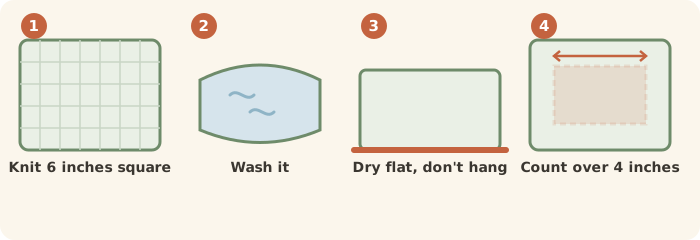
Knit a swatch at least 6 inches square in the pattern's stitch, wash and dry it as you will the finished piece, then count the stitches across 4 inches in the middle. Too few stitches per inch means going down a needle size; too many means going up.
Each needle size changes your gauge by roughly half a stitch per inch.
Almost every disappointing finished garment traces back to the same skipped step. Not a difficult technique, not an ambitious pattern — just the small square of fabric nobody wants to make before the interesting part begins.
Here is the uncomfortable arithmetic. If your gauge is half a stitch per inch looser than the pattern's, a 40-inch jumper comes out nearly four inches too big. Half a stitch. You would never notice it in a single row, and it is the difference between a jumper you wear and one you fold away.
What gauge actually is
Gauge is simply how many stitches and rows you produce in a given measurement, usually four inches or ten centimetres. It is not a property of the yarn or the needle alone — it is the three-way result of yarn, needle size and your own hands. Two people using identical materials will often produce different gauge, and neither is wrong.
Do the sums for me
Our gauge and pattern resizer tells you whether you're on gauge, which way to change needles, and — most usefully — how many stitches to cast on for the size you actually want using your own gauge.
Swatching properly
Make it big enough
At least six inches square. Edge stitches curl and distort, so you need settled fabric in the middle to measure honestly. A four-inch swatch gives you nothing but edges.
Use the stitch the gauge refers to
If the pattern gives gauge in stocking stitch, swatch in stocking stitch. Cable and textured patterns pull in considerably, so a swatch in the wrong stitch will mislead you completely.
Wash and dry it
The step most often skipped and most often regretted. Superwash wool can grow noticeably; cotton and linen relax. Treat the swatch exactly as you'll treat the finished piece.
Measure in several places
Lay it flat without stretching, count over four inches in two or three spots, and take the average. Fabric is never perfectly even, and one reading can flatter or mislead.
Don't unravel the swatch. Keep it, with a note of the yarn, needle size and washing method pinned to it. Six months later when you want to make something else from the same yarn, that little square will save you the whole exercise.
Which way to change needles
This confuses everyone at first because it feels backwards. If you have too few stitches per inch, your stitches are too big, so you go down a needle size. Too many stitches per inch means they're too small, so go up. The trick is remembering you're counting stitches per inch, not measuring stitch size — squeeze more stitches into an inch and each one must be smaller.
Expect roughly half a stitch per inch of change for each needle size. If you're two full stitches out over four inches, you'll likely move a couple of sizes.
When you simply cannot get gauge
Sometimes no needle gives both the right numbers and a fabric you like. When that happens, choose the fabric every time. A jumper knitted at a gauge that produces stiff, boardy cloth will never be worn, whatever the tape measure says.
Then recalculate. Take your own gauge, multiply by the width you want, and cast on that number instead of the pattern's. This is not cheating — it's what experienced knitters do quietly and constantly. Our calculator will convert every stitch count in the pattern for you.
Does row gauge matter?
Less than stitch gauge, most of the time, because patterns usually tell you to work until a piece measures a certain length. Where it does matter is in shaping spread over a set number of rows — raglans, armholes, sleeve caps — and in anything worked sideways. If your pattern shapes by row count rather than measurement, check row gauge too and adjust.
Crochet is exactly the same
Everything above applies with hooks instead of needles. One extra thing to watch: crochet gauge is usually given over a specific stitch, and double crochet, half double and granny clusters produce very different fabrics. Swatch in the stitch the pattern names, not whichever you find comfortable.