
Macramé Basics: Cord, Knots and How Much You Need
Cut each cord about four times the finished length, then double it over your dowel — so a 40 inch wall hanging needs cords cut to roughly 160 inches, folded to 80.
Dense knotting needs more; loose, airy designs need less. Always cut generously, because you cannot add length to a cord mid-piece.
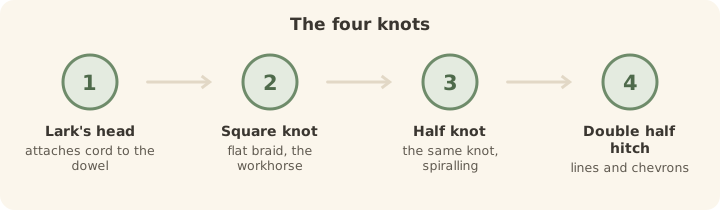
The four knots
Lark's head
How every cord attaches to the dowel. Fold the cord in half, pass the loop behind the dowel, then pull the two ends through the loop and tighten.
Square knot
The workhorse. Four cords: the outer two knot around the inner two, left over right and then right over left. Repeating it makes a flat braid.
Half knot
Half of a square knot, repeated. Because it always goes the same way, the work twists into a spiral — the classic look on plant hangers.
Double half hitch
Knots worked over a guide cord to make lines, diagonals and chevrons. This is where macramé stops being braid and starts being a design.
Choosing cord
| Cord | Character | Best for |
|---|---|---|
| 3-ply twisted | Unravels into a soft fringe | Wall hangings with combed fringe |
| Single twist | Very soft, fringes beautifully | Fringe-heavy decorative pieces |
| Braided | Smooth and strong, won't fringe | Plant hangers, bags, anything load-bearing |
| Jute or hemp | Rustic and rough on hands | Outdoor and rustic pieces |
Cut long, and cut once. The four-times rule is a guide, not a guarantee — dense square-knot panels can eat six times the finished length. Running short means starting a piece again, while leftover cord becomes fringe. Err generously every time.
Cord thickness
3 mm suits detailed work and jewellery; 4 to 5 mm is the everyday choice for wall hangings and plant hangers; 6 mm and above makes bold chunky pieces quickly but is harder on the hands and needs a sturdy dowel.
Keeping it even
Hang your work at a comfortable height on a rail or a hook rather than working flat on a table — gravity keeps the cords aligned and your knots consistent. Measure down from the dowel with a tape as you go rather than trusting your eye, and mark the level of each row of knots with a pin if the design is symmetrical.
Questions we're often asked
How much cord do I need for macramé?
About four times the finished length for each cord, then doubled over the dowel. Dense knotting can need up to six times, so cut generously.
What cord is best for a plant hanger?
Braided cotton cord of 4 to 5 mm. It's smooth, strong and doesn't fringe, which matters when the piece has to carry the weight of a pot.
Why does my macramé twist to one side?
You're working half knots rather than square knots. A half knot always turns the same way and spirals deliberately; alternating the direction gives you a flat square knot instead.