
Pricing Handmade Items Without Underselling Yourself
Almost every maker who sells prices too low at first, then quietly gives up because it isn't worth the hours. A formula won't make your work sell, but it will stop you losing money on every sale.
The basic formula
The most widely used starting point:
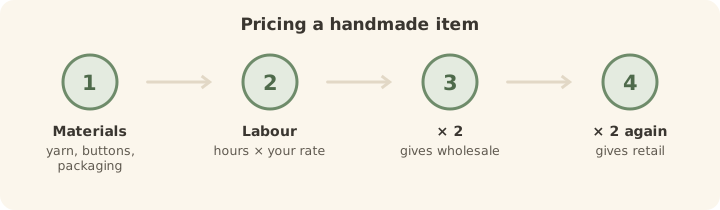
(Materials + Labour) × 2 = wholesale price. Wholesale × 2 = retail price.
The doubling isn't greed — it covers your overheads, the pieces that don't sell, marketplace fees, packaging, and the hours spent photographing and listing rather than making. If you only ever sell directly, you might use a smaller multiplier, but never simply materials plus time.
Count materials honestly
Not just the yarn. Include the proportion of the yarn actually used, buttons, labels, packaging, postage materials, and the pattern if you bought it. Weighing the finished item and working back to yardage is the most accurate way — our yardage calculator converts grams to yards so you can cost it properly.
Know exactly what you used
Weigh the finished piece and the leftover yarn, and you have your true material cost. Our yardage and substitution calculator turns those grams into yards and balls.
Labour is the part people skip
Time yourself honestly on one item, including the finishing and weaving in of ends. Then pick an hourly rate you can say out loud without wincing. Many makers use their local minimum wage as an absolute floor and go up from there with experience.
Here's the uncomfortable arithmetic: a hand-knitted jumper takes 30 to 40 hours. At any honest hourly rate, that jumper costs several hundred pounds — which is precisely why hand-knitted jumpers rarely sell, and why successful makers concentrate on smaller, faster items.
Choose products by time, not by preference. Hats, dishcloths, small amigurumi, bookmarks and jewellery can be made in an hour or two and sell at a price people will actually pay. Blankets and jumpers are labours of love — make them as gifts, not as stock.
Don't compete with factories
Someone will always undercut you with a machine-made item, and you cannot win that fight. What you can offer is customisation, quality, a story, and the fact that it was made by a person. Price accordingly, and sell to people who want that rather than to people comparing you with a supermarket.
Practical things to remember
- Marketplace fees and payment processing take roughly 10% before you see anything.
- Postage costs more than people expect, and offering "free postage" means building it into the price.
- Custom orders take longer than you estimate. Charge extra for them, always.
- Check whether patterns you use permit selling finished items — many designers allow it, some don't, and it's usually stated in the pattern.
Questions we're often asked
How do I price handmade items?
Add materials and labour, then multiply by two for wholesale and by two again for retail. The multiplier covers overheads, fees, packaging and the unsold stock that every maker carries.
What hourly rate should I charge?
Start at your local minimum wage as an absolute floor and increase it as your skill and reputation grow. Anything lower and you are paying for the privilege of working.
Why don't hand-knitted jumpers sell?
Because 30 to 40 hours of labour at any fair rate puts them beyond what most buyers will pay. Makers who sell successfully concentrate on items that take one or two hours.