
How Much Ribbon Do I Need for a Bow?
Rather more than you think, is the honest answer — and that is how so many of us end up two loops short on a Sunday afternoon with the craft shop closed. Ribbon disappears surprisingly fast once you start looping it.
The arithmetic of a bow
Every loop uses roughly twice its width in ribbon, plus a little extra where it gathers at the centre. A five-inch loop therefore takes about ten inches of ribbon, and a six-loop bow uses around sixty inches before you have added a single tail.
Then come the tails, usually twelve inches each and often two of them, and the wrap around the middle where the wire goes. Add a sensible margin for the loop that doesn't sit right and has to be redone, and a modest six-loop wreath bow comes to about three yards.
Work out your exact yardage
Our ribbon and bow calculator takes your loop count, loop size, tail length and ribbon width and gives you the total in yards, inches and metres — plus how many standard rolls to buy and how much wire you'll need for the centre. It even sketches the bow so you can see the shape before you cut.
Common bows and their yardage
- Small gift bow — 4 loops of 3 inches: about 2 yards.
- Classic wreath bow — 6 loops of 5 inches with 12-inch tails: about 3 yards.
- Large wreath bow — 8 loops of 6 inches: about 4.5 yards.
- Statement bow — 10 loops of 7 inches with long tails: about 6 yards.
Craft store rolls are most often ten yards, which comfortably makes three classic wreath bows with a little left over.
Choosing a width
Ribbon width sets the whole character of a bow. Wired ribbon at 2.5 inches is the everyday workhorse — it suits most wreaths, holds its shape and is forgiving to work with. Four-inch ribbon reads as full and generous on a large door wreath. Slimmer 1.5-inch ribbon is right for gift bows, small arrangements and delicate work.
As a guide, match the ribbon to the wreath: a slim 18-inch wreath carries 2.5-inch ribbon beautifully, while a full 24-inch wreath can take 4-inch without looking overwhelmed.
Wired ribbon is worth the extra
Wired ribbon has a fine wire running along both edges. It means loops stand up by themselves, hold their shape through a season on the front door, and — best of all — can be fluffed and reshaped as often as you like. Unwired ribbon drapes softly and is lovely for tails and for wrapping presents, but it will not hold a loop upright without help. For wreath bows, buy wired.
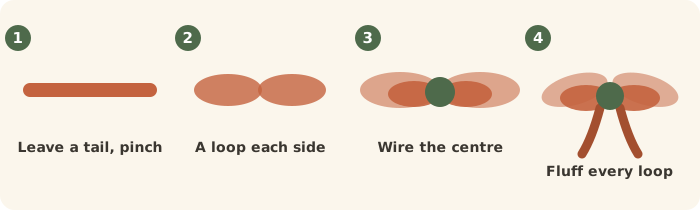
Making the bow
Leave your first tail
Let the length you want for a streamer hang free, then pinch the ribbon between finger and thumb. Everything is built from that pinch point.
Make a loop to one side
Bring it back to the centre and pinch, giving the ribbon a half twist so the right side always faces outward. Wired ribbon holds the shape while you work.
Match it on the other side
Keep alternating, and make each pair slightly smaller than the last. That graduation is what gives a bow its full, layered look rather than a flat one.
Wire the centre
Wrap floral wire or a pipe cleaner tightly around the pinched centre and twist it at the back. Pull harder than feels comfortable — a loose centre lets the whole thing sag.
Cut the tails and fluff
Cut at an angle or in a V, then ease every loop apart and turn it to catch the light. Five minutes here is the difference between a flat bow and the one you pictured.
Buy the whole roll
Ribbon is one of those supplies where the difference between just enough and comfortably enough is a pound or two. Buying spare means you can redo a bow that hasn't sat right, and leftover ribbon has never gone to waste in any craft room I know of.