
How Much Wax Do I Need for a Candle?
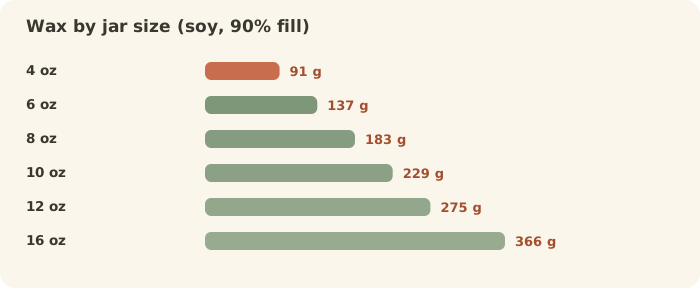
Here is the small puzzle at the heart of candle making: jars are sold by volume, and wax is sold by weight. An eight-ounce jar does not take eight ounces of wax, and working out what it does take trips up nearly everyone on their first pour.
The rule of thumb
For soy wax in a container, the wax weight in ounces is about 80% of the jar's fluid-ounce size. An 8 oz jar takes roughly 6.5 oz of wax. A 12 oz jar takes about 9.6 oz. It's not exact, but it will keep you out of trouble at the shop.
Why 80%? Two reasons. Soy wax is slightly lighter than water — about 0.86 grams per millilitre — and you don't fill a jar to the brim, since a candle needs a little headspace at the top. Put those together and the arithmetic lands close to four fifths.
Let the calculator do it
Our candle wax calculator takes your container's measurements — or its volume, if you already know it — and tells you the wax weight, the fragrance oil to add, the total in the pot, and a starting wick size. It handles soy, paraffin, beeswax, coconut blends and palm.
Measuring an awkward container
Teacups, vintage tins, hand-thrown pottery — the loveliest vessels are rarely neat cylinders. There is a simple trick for these: fill the empty container with water up to your intended fill line, then pour that water into a measuring jug. Whatever it reads in millilitres is your volume, and you can feed that straight into the calculator. Dry the container thoroughly afterwards, of course.
Fragrance load, explained plainly
Fragrance load is the amount of scent relative to the wax, given as a percentage of the wax weight. At a 10% load, 200 grams of wax takes 20 grams of fragrance oil. Ten per cent is the standard for most container waxes and gives a good scent throw without trouble.
It is tempting to think more oil means more fragrance. Beyond what the wax can hold, it doesn't — the excess simply seeps out, leaving oily patches on the surface, weakening the candle and, in the worst case, creating a fire risk. Check what your wax is rated for and stay within it.
One other thing: always weigh fragrance oil rather than measuring spoonfuls. Oils vary in density, so volume measurements will make your candles inconsistent from batch to batch. A set of digital kitchen scales that reads to the gram is all you need.
Melt extra — always
Wax clings. It coats the pouring jug, the spoon, the thermometer, and it sets fast once it leaves the heat. Melt about 10% more than your calculated figure and you'll never find yourself twenty grams short with three wicked jars waiting on the worktop.
Choosing a wick
Wick size depends on the width of your container, but also on the wax, the fragrance and any dye you've added — which is why every experienced candle maker tests rather than trusts a chart. Pour one candle first, let it cure, then burn it for a few hours and watch:
- The melt pool should reach the edges of the jar within about two hours.
- A small, drowning flame that leaves hard wax at the sides means going up a size.
- A tall, flickering flame with soot means going down a size.
Give it time to cure
A candle poured today will not smell its best today. Soy wax in particular needs a week or two for the fragrance to bind into the wax properly. Many a new candle maker has burned a candle the next morning, decided the fragrance was a failure, and been delighted a fortnight later. Pour, wick, wait — then judge.