
How to Read a Cross Stitch Chart
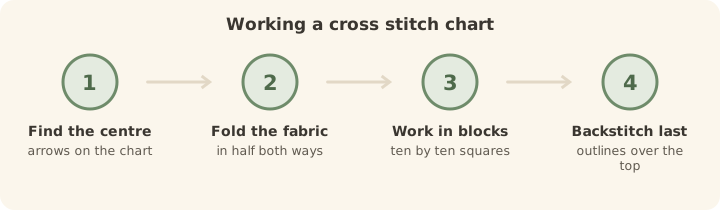
A cross stitch chart is a grid where every square is one stitch and every symbol is one colour. Once you know the conventions, even a large chart is simply a map you follow one square at a time.
Start at the centre
Nearly every chart marks its centre with small arrows on the edges. Fold your fabric in half both ways to find its centre too, and begin there. Starting at a corner is how pieces end up running off the edge of the fabric.
Symbols and the key
Each symbol corresponds to one floss colour, listed in the key with a DMC or Anchor number. Symbols are chosen for contrast rather than resemblance, so don't expect the shapes to mean anything. If two symbols look alike on a printed chart, mark one with a coloured pencil before you start.
Work out the size before you cut
The chart gives a stitch count; our fabric calculator turns it into a finished size on every fabric count and tells you exactly what to cut once margins are added.
The heavy grid lines
Charts are divided into blocks of ten squares by darker lines. Use them for counting — count in tens rather than ones and you'll make far fewer errors. Many stitchers also grid their fabric with washable thread in matching ten-by-ten squares, which sounds tedious and saves an enormous amount of unpicking on large projects.
Full, part and back stitches
- Full cross stitch — a whole square with a symbol. The bulk of any design.
- Half stitch — a single diagonal, shown as a triangle in half the square. Often used for shading and backgrounds.
- Quarter and three-quarter stitches — for curves and detail, shown as a symbol in part of a square.
- Backstitch — the outlines, shown as straight lines on the chart rather than symbols in squares. Always worked last, usually in one strand.
- French knots — shown as filled dots. Eyes and berries.
Keep your top stitches all slanting the same way. It matters far more to the finished appearance than perfectly even tension. Pick a direction on your first stitch and never vary it.
Working in blocks
Complete one ten-by-ten block before moving on, rather than jumping around the design. It keeps your counting anchored and gives a satisfying sense of progress. Work the darkest colour first if you like seeing the picture emerge early.
Parking, for confetti-heavy charts
Some modern charts have single stitches of dozens of colours scattered about — "confetti". The parking method has you work one column at a time, leaving each threaded needle parked in the next square that colour appears. It looks chaotic and is dramatically faster than rethreading constantly.
Questions we're often asked
Where do I start a cross stitch chart?
At the centre. Find the arrows marking the chart's centre, fold your fabric in half both ways to find its centre, and begin there so the design stays properly placed.
What do the lines rather than symbols mean?
Those are backstitch outlines, worked after all the cross stitches are done, usually in a single strand of floss.
How many strands should I use?
Two for full cross stitches on 14 count Aida, and one for backstitch. Use three on 11 count and one or two on 18 count.