
Aida Cloth Counts Explained: 11, 14, 16 and 18
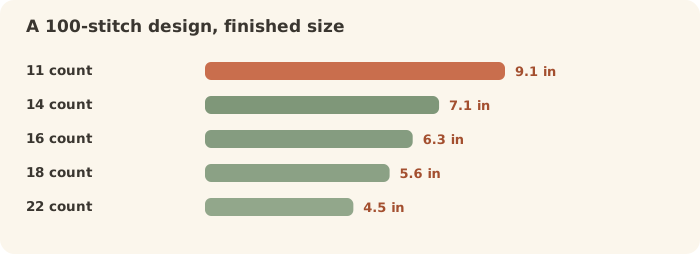
Every piece of cross stitch fabric comes with a number attached, and that number decides how big your finished piece will be. It is worth understanding properly, because it is the difference between a design that fits the frame you bought and one that doesn't.
What the count actually measures
The count is how many stitches fit into one inch of fabric. On 14 count Aida you get fourteen stitches per inch; on 18 count you get eighteen. A higher number means smaller stitches and a smaller finished piece from the very same chart.
So a design that is 140 stitches wide comes out at exactly ten inches on 14 count, but only about 7.8 inches on 18 count. Nothing about the pattern has changed — only the scale of every stitch in it.
See the difference for your own pattern
Our cross-stitch fabric calculator takes your pattern's stitch count and shows the finished size on every fabric count side by side, along with exactly what size fabric to cut once margins are added.
The common counts, and who they suit
- 11 count — large, generous stitches with very visible holes. Wonderful for beginners, for children learning, and for anyone who would rather not squint. Designs come out big and bold.
- 14 count — the everyday standard. Most kits, most charts and most shop-bought fabric assume it. A comfortable balance of detail and ease.
- 16 count — a step finer. Noticeably more detail, still manageable in good light.
- 18 count — fine work. Beautiful for detailed portraits and samplers, but demanding on the eyes and slower to stitch.
Evenweave and linen: divide by two
Aida is woven in tidy blocks, so one stitch sits neatly in one block. Evenweave and linen are woven more finely and are counted in threads per inch, with stitchers usually working over two threads at a time.
That gives the single most useful rule in cross stitch: divide an evenweave count by two to find its Aida equivalent. 28 count evenweave stitched over two threads gives fourteen stitches per inch — exactly the same size as 14 count Aida, but with a softer, more elegant finish. 32 count over two matches 16 count Aida, and so on.
Don't forget the margins
The stitched area is not the fabric you need to buy. Allow three inches of spare fabric on every side — that is six inches added to both the width and the height. Those margins give you something to hold, room to mount the work in a hoop or on a frame, and the space a framer needs to stretch the piece properly.
Cutting close to the design is the most common regret in this hobby. Fabric is inexpensive; a finished piece that cannot be framed is heartbreaking.
Choosing a count that's kind to you
There is no prize for stitching finer. A great many long-time stitchers move from 18 count to 14, and later to 11, and their work is no less lovely for it — often more striking, because the colours read boldly at a larger scale. If you're finding your current fabric a strain, the answer is not to persevere but to drop a count and enjoy yourself.
Two other things help more than most people expect: a daylight bulb in a good lamp positioned over your shoulder, and a magnifier on a stand rather than one held in the hand. Between them they can add years of comfortable stitching.
A quick reference
For a design 100 stitches square, the stitched area works out at roughly 9.1 inches on 11 count, 7.1 inches on 14 count, 6.3 inches on 16 count and 5.6 inches on 18 count. Add six inches to each dimension for margins, and you have your shopping list.