
How Many Stitches to Cast On for a Hat
Hats are the perfect small project — a single ball, a weekend, a gift sorted. They are also the project people most often make too big, because of one counterintuitive rule: a hat should be smaller than the head it goes on.
Negative ease, explained
Knitted and crocheted fabric stretches. A hat made to the exact measurement of the head has nothing holding it in place — it gapes at the ears, slides back off the forehead and needs pulling down every few minutes. Making it about 10% smaller lets the fabric stretch to fit and grip gently. That 10% is called negative ease, and it is what separates a hat that stays put from one that doesn't.
So a 22½ inch head wants a hat measuring about 20¼ inches around. It will look far too small lying flat. Trust the arithmetic.
Get your cast-on number
Our hat size calculator takes the head measurement and your gauge and gives you the cast-on, the length to work before the crown, the ribbing depth and the yarn you'll need — for knitting or crochet.
How much ease for which fabric
- 10% — the standard, and right for most wool hats in stocking stitch or a simple pattern.
- 15% — for very springy ribbing, which stretches a great deal and recovers well.
- 5% — for bulky yarns and firm crochet fabric, which have far less give.
- None — for slouchy hats meant to sit loosely at the back.
Measuring a head
Run a soft tape around the head just above the ears and across the middle of the forehead — the widest part — snug but not tight. If the hat is a surprise, measure a hat they already wear and like: lay it flat, measure across the brim and double it.
Averages, when you truly can't measure: 15 inches for a newborn, 19 for a toddler, 20 for a child, 22½ for an adult woman and 23½ for an adult man.
Swatch in the body stitch, never the ribbing. Ribbing pulls in dramatically, so gauge measured over it comes out far too high — and the resulting hat will be comically large. Swatch in whatever stitch the main body uses.
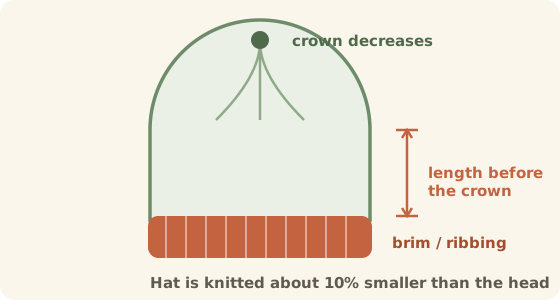
How long before the crown
Work about 7 to 8 inches from the cast-on edge for a standard adult beanie before starting the crown decreases, which add roughly two more inches. A slouchy hat wants 9 to 10 inches, a close cap 6½ to 7. If you like a folded brim, add the depth of the fold on top — a two-inch turn-back means two extra inches of knitting, and forgetting this is how hats end up sitting on the crown of the head rather than covering the ears.
Closing the crown
Decreases are usually spread over six or eight points, which is why cast-on numbers are often rounded to a multiple of 8 or 12. Divide the stitches into equal sections, decrease one stitch per section every other round to begin with, then every round as the crown tightens, until 8 to 12 stitches remain. Break the yarn, thread it through those stitches with a yarn needle, draw it up firmly and fasten off inside.
One ball, one hat
An adult DK beanie takes around 150 to 200 yards, a child's about 120, and a baby hat well under 100. This makes hats the natural home for the single balls left over from bigger projects — and a very good way to use up a skein you fell in love with and bought without a plan.