
Crafting Comfortably: Hands, Light and Setting Up Well
Nobody takes up knitting or cross stitch expecting to think about ergonomics. Yet the difference between a craft you enjoy for decades and one you quietly give up often comes down to a few practical things: how you sit, how the light falls, and whether your hands ache afterwards.
Light does more than anything else
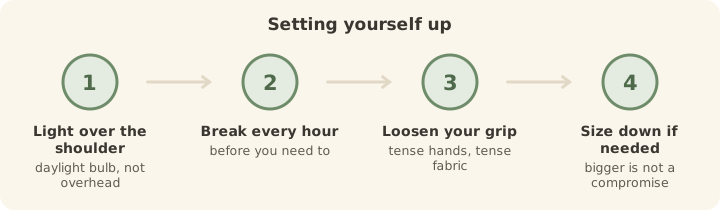
If one change is worth making, it's this. A daylight-balanced bulb in a lamp positioned over your shoulder — not in front of you, which casts your own shadow onto the work — transforms how easily you can see stitches, count holes in Aida and tell navy from black.
Our eyes need noticeably more light as we get older; by sixty, roughly three times as much as at twenty for the same task. That isn't a failing, it's ordinary biology, and the answer is simply a better lamp rather than finer fabric or stronger glasses.
Choose a count that's kind to you
If your current fabric feels like a strain, dropping a count is not a step backwards. Our cross-stitch calculator shows the same design's size on every fabric count, so you can see exactly what changing to 14 or 11 would mean.
Hands and wrists
- Take breaks before you need them. Ten minutes of movement every hour beats an hour of recovery afterwards. Set a timer if you're the sort who loses track — most of us are.
- Loosen your grip. Tension in the hands usually means tension in the fabric too. If your stitches are tight, your hands probably are.
- Try ergonomic hooks and needles. Soft, wider grips reduce the pinch that aggravates thumb joints. A foam pencil grip on an ordinary hook does much the same for pennies.
- Warm hands work better. A warm wheat bag or a bowl of warm water before you start makes a real difference on cold days.
- Vary the craft. Knitting, crochet and stitching use the hands differently. Alternating between them spreads the load.
Pain is information, not a challenge. Aching after a long session is common; sharp pain, numbness or tingling is worth mentioning to a doctor rather than working through. Most hand problems respond far better to early attention than to determination.
How you sit
A chair with arms lets your elbows rest, which takes the weight of your forearms off your shoulders. Keep the work up near chest height rather than down in your lap — a cushion on the knees raises it and saves a great deal of neck bending. And if you find yourself hunching towards the work, that's a light problem more often than a posture problem.
Magnification, done properly
A magnifier on a stand beats a hand-held one every time, because it leaves both hands free. Neck-worn magnifiers suit some people and irritate others; try before committing. Clip-on lenses that attach to your glasses are inexpensive and surprisingly effective for close work.
Bigger is not a compromise
There is no prize for stitching on 18 count or knitting with 2 mm needles. Many long-time crafters move happily to 14 or 11 count fabric, to DK instead of fingering, to bulkier yarn and larger hooks — and the results are no less beautiful. Often they're more striking, because colours read boldly at a larger scale and the work grows fast enough to stay satisfying.
The best craft is the one you're still doing in ten years. Setting yourself up comfortably isn't giving in; it's how that happens.