
Crochet Hook Sizes Explained: Letters, Numbers and Millimetres
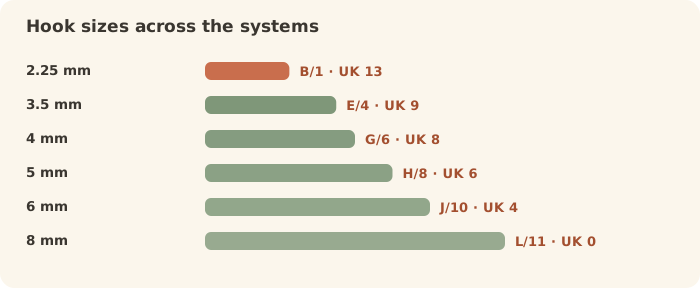
Pick up a crochet hook and it may be marked H, or 8, or 5 mm — and all three can mean the same hook. It's a muddle with a simple explanation: three systems grew up in different places and none of them gave way.
The three systems
- Millimetres — the actual thickness of the shaft. Unambiguous, used worldwide, and the only measurement that means the same thing everywhere.
- American letters and numbers — B/1, C/2, D/3 and so on, rising through the alphabet as the hook gets thicker. Confusingly, the letter and number are both given, and the numbers don't line up with anything else.
- Old British numbers — these run backwards, like old knitting needle sizes. A British 14 is a fine 2 mm hook; a British 000 is a chunky 10 mm.
So an H/8 hook is 5 mm, which is a British 6. When a pattern gives only a letter or only a number, check where it was published before reaching into your hook case.
Identify an unmarked hook
Markings wear off with use, and many hooks arrive unlabelled in sets. Our needle and hook sizer lets you lay the hook against true-size bars on your screen and read off the size in every system at once.
Measure the shaft, not the head
The size of a hook is the diameter of its shaft — the straight section between the head and the thumb rest. That's the part that determines your stitch size, because every loop is formed around it. Measuring at the head or the grip will give you the wrong answer.
The steel hook exception
Thread hooks for lace and doilies use an entirely separate numbering, running from about 00 down to 14, where — you've guessed — higher numbers mean finer hooks. A size 7 steel hook is around 1.65 mm, far finer than anything in a standard yarn hook set. If a vintage doily pattern calls for a size 10 hook and yours is enormous, this is why.
Which hook for which yarn?
Ball bands suggest a hook size, and it's a reasonable starting point rather than a rule:
- Fingering / 4 ply — 2.25 to 3.5 mm
- Sport / 5 ply — 3.5 to 4.5 mm
- DK / 8 ply — 4 to 5 mm
- Worsted / Aran — 5 to 6.5 mm
- Chunky — 6.5 to 9 mm
Crocheters vary more than knitters in tension, so many people habitually go up or down a size from the band's suggestion. If your fabric feels stiff and boardy, go up. If it's loose and gappy when it shouldn't be, go down. And for amigurumi, deliberately go smaller than suggested — you want a dense fabric that stuffing can't escape through.
Inline or tapered? Hook heads come in two shapes and crocheters have firm opinions. Inline hooks have a head the same width as the shaft, giving very consistent stitches. Tapered hooks have a rounder head that slides into stitches more easily. Neither is better — but if your tension changes when you switch brands, this is usually the reason.
Comfort matters more with age
If your hands ache after an hour, the answer is rarely to work through it. Hooks with soft ergonomic grips make an enormous difference for anyone with arthritis or a stiff thumb, and they cost very little. Some crocheters slip a foam pencil grip onto an ordinary hook, which works almost as well for pennies.