
Teaching a Child to Knit or Crochet
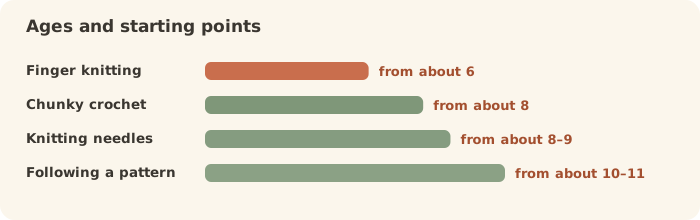
Around age six or seven for finger knitting, eight or nine for needles and hooks. Use chunky yarn, short wooden needles or a 5–6 mm hook, and a light colour so stitches are visible.
Keep sessions to 15 minutes and let the first project be something finished within two.
Getting started well
Start with finger knitting
No tools, instant results, and it teaches the essential idea — a loop pulled through a loop. Many children are happy here for months, and that's fine.
Cast on for them
Casting on is fiddly and frustrating and has nothing to do with the pleasure of knitting. Do it for them for the first several projects; they'll pick it up later without ever finding it a barrier.
Sit alongside, not opposite
A child copies what they see. Sitting beside them means your hands move the same way as theirs. Opposite means everything is mirrored, which confuses right-handers and left-handers alike.
Finish something fast
A doll's scarf, a phone cosy, a small square for a group blanket. Nothing kills enthusiasm like a project that never ends — and nothing builds it like showing someone a finished thing.
Sizing a child's project
Making a hat for the child themselves is enormously motivating. Our hat size calculator has child head sizes built in and gives the cast-on from whatever chunky yarn you're using.
Materials that help
| Item | Choose | Because |
|---|---|---|
| Yarn | Chunky, smooth, light-coloured | Stitches are big and clearly visible |
| Needles | Short wooden, 6–8 mm | Grip the yarn; short is easier for small hands |
| Hook | 5–6 mm with a soft grip | Comfortable and easy to see the stitch |
| First project | A small square | No shaping, quick finish, useful for a group blanket |
Fix mistakes quietly, or not at all. Dropped stitches and holes don't matter in a child's first scarf. If you unpick their work in front of them, they learn that their effort was wrong. Pick up the dropped stitch while they're out of the room, or simply let it be part of the scarf.
Signs to stop for the day
Frustration, gripping the needles hard, or the yarn getting thrown. Fifteen minutes is a long time for a child's concentration, and stopping while it's still fun is what makes them come back to it. "Let's do a bit more tomorrow" is almost always the right answer.
Left-handed children
For knitting, teach the standard way — knitting uses both hands roughly equally and every future pattern and video will make sense. For crochet, which is genuinely one-handed, let them hold the hook in whichever hand feels natural and mirror the instructions.
Questions we're often asked
What age can a child learn to knit?
Around eight or nine for needles, and six or seven for finger knitting. It depends far more on patience and fine motor skills than on exact age.
What yarn is best for teaching a child?
Smooth chunky yarn in a light colour, with wooden needles of 6 to 8 mm. Big visible stitches and needles that grip the yarn make everything easier.
How long should a lesson be?
About fifteen minutes. Stop while they're still enjoying it, and they'll ask to do it again — which is the whole aim at the start.