
Left-Handed Knitting and Crochet: What Actually Changes
Left-handed crafters are often told to simply mirror everything, which is true and unhelpful. Here's what genuinely differs, and the honest answer about whether you should learn right-handed instead.
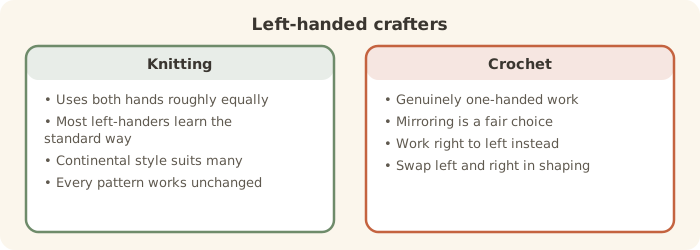
Knitting is mostly two-handed anyway
This surprises people. Knitting uses both hands roughly equally — one holds the stitches, the other manipulates the yarn — so most left-handers learn perfectly well from standard instructions. Many find continental style, where the left hand controls the yarn, particularly comfortable.
Because of this, the usual advice for knitting is to learn the standard way. You'll be able to use every pattern, every video and every class without translation, and your hands will adapt within a few evenings.
Crochet is genuinely one-handed
Here the case is different. The hook does nearly all the work, and holding it in the non-dominant hand is a real disadvantage. Left-handed crochet — working right to left instead of left to right, mirroring everything — is a legitimate choice and many left-handers are far happier with it.
Gauge works the same either way
Whichever hand you work with, the arithmetic doesn't change. Our gauge calculator compares your swatch to the pattern and converts stitch counts to your own gauge.
What to do with patterns
- Symmetrical items — hats, scarves, granny squares, most blankets — need no changes at all. Work as written.
- Asymmetric shaping — a cardigan with a left and right front — needs the instructions swapped. Work the "right front" instructions for the left front, and vice versa.
- Decreases lean the other way. Where a pattern pairs k2tog and ssk for mirrored shaping, you'll swap them to keep the visual effect.
- Charts for left-handed crochet are read from the opposite side. Some crafters hold the chart up to a mirror or a bright window, which works surprisingly well.
A mirror is the easiest teaching aid there is. Sit a right-handed teacher or a video opposite you and watch their reflection, or simply position yourself facing them rather than beside them — what you see is then exactly what your hands should do.
Cables and colourwork
Cables cross the opposite way if you mirror everything. On most designs this is unnoticeable; on a deliberately directional design it changes the look. Colourwork charts are read in the opposite direction, which matters for anything with text or asymmetric motifs — those come out backwards unless you flip the chart.
Questions we're often asked
Should left-handers learn to knit right-handed?
Usually yes, because knitting uses both hands fairly equally and it means every pattern and tutorial works without translation. Crochet is different — it's genuinely one-handed, and mirroring is a reasonable choice.
How do I mirror a crochet pattern?
Work in the opposite direction, right to left, and reverse any directional instructions. Symmetrical projects need no changes at all; asymmetric ones need left and right swapped throughout.
Do I need left-handed hooks or needles?
No. Needles and hooks are symmetrical tools and work identically in either hand. Only the instructions need translating.