
Sock Sizes: Foot Measurements and Stitch Counts
Socks are the project most likely to be abandoned halfway, usually because the first one came out too loose and nobody fancies making a second. The fix is knowing two numbers before you cast on.
The two measurements that matter
Measure around the ball of the foot at its widest, and measure the foot from heel to toe. The circumference decides your stitch count; the length decides when to start the toe.
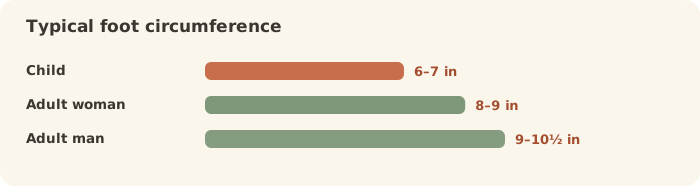
Typical foot circumferences: child 6 to 7 inches, adult woman 8 to 9, adult man 9 to 10½.
Socks need negative ease
Like hats, socks are knitted smaller than the foot so they grip rather than wrinkle. Aim for about 10% smaller than the foot circumference — so an 8½ inch foot wants a sock measuring around 7½ inches around. A sock knitted to the actual measurement will sag at the ankle within an hour.
Turning that into stitches
Multiply your target circumference by your stitches per inch. Our gauge calculator does it for you and rounds the number to a multiple that suits your rib pattern and heel construction.
Common stitch counts
At the usual sock gauge of 8 stitches per inch in fingering weight on 2.25 to 2.5 mm needles: 56 stitches for a small adult foot, 60 to 64 for an average woman's, and 68 to 72 for a man's. These are the numbers most sock patterns are built around, which is why fingering weight and 2.25 mm needles are so standard.
Where to start the toe
Work the foot until it measures about 2 inches short of the total foot length, then begin the toe decreases. For a 9½ inch foot, that means knitting to 7½ inches from the back of the heel before starting to shape.
Make the second sock immediately. Second sock syndrome is real, and the cure is starting sock two the same evening you finish sock one — while the pattern, the row counts and your modifications are still fresh. Knitters who work two at a time on a long circular never face it at all.
Cuff length and yarn
A standard adult sock has a 6 to 7 inch leg from cuff to the top of the heel. Ankle socks run 2 to 3 inches, and knee socks 14 or more — which need shaping down the calf and considerably more yarn.
A pair of adult socks takes roughly 350 to 450 yards of fingering weight, which is why sock yarn is sold in 100 gram skeins of around 400 yards. If you have larger feet or want longer legs, buy two skeins.
Questions we're often asked
How many stitches for an adult sock?
At 8 stitches per inch in fingering weight, 60 to 64 stitches suits an average woman's foot and 68 to 72 a man's. Adjust to your own gauge rather than borrowing a number.
How much negative ease should socks have?
About 10%. A sock knitted to the exact foot measurement will sag and wrinkle; one knitted 10% smaller stretches to grip comfortably.
How much yarn does a pair of socks take?
Around 350 to 450 yards of fingering weight for an adult pair. A standard 100 gram skein of sock yarn usually holds about 400 yards, which is why it's sold that way.