
Knitting Small Circles: Magic Loop, DPNs or Two Circulars
At some point every knitter meets a tube too small for a circular needle. There are three solutions, all producing identical fabric, and knitters have firm preferences about which is least annoying.
Double-pointed needles
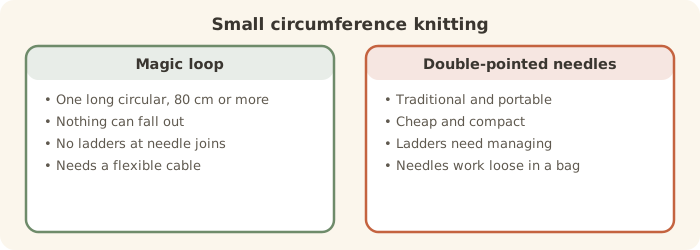
The traditional method: stitches divided across three or four needles, knitting with a fifth. Compact, portable and cheap, and it produces beautiful results.
The drawbacks are real though — needles work loose and fall out of a bag, and you get "ladders", loose columns where one needle meets the next. The fix for ladders is to give the first two stitches of each needle a firm tug, and to shift the join point every few rounds so the strain never lands in the same place.
Magic loop
One long circular needle, at least 80 cm, with the cable pulled out in a loop at each side. Nothing can fall out, everything is on one needle, and the same needle knits socks, sleeves and hat crowns.
It feels clumsy for the first few rounds and then becomes second nature. Most knitters who switch to magic loop never go back, though it does need a flexible cable — stiff cables make it a fight.
Which needle is that?
Sock and sleeve needles are small and lose their markings fastest. Our needle sizer identifies an unmarked needle against true-size bars on your screen.
Two circulars
Half the stitches on each of two circular needles, knitting each half with its own needle. Popular for two-at-a-time socks, and it avoids both ladders and dropped needles. The trade-off is more equipment and more cables to keep track of.
Joining without twisting. Whichever method you use, lay the work flat before joining and check that the cast-on edge runs unbroken along the bottom with no spiral. A twisted join cannot be fixed later — it means starting again, and it happens to everyone at least once.
Which to choose
If you already own DPNs, learn to manage the ladders and carry on. If you're buying, one 100 cm circular in your usual sock size will do everything, cost less than a set of DPNs, and never fall out on a train.
Sleeves specifically
Sleeves start wide and narrow as you go, which means starting on a short circular and switching to magic loop or DPNs partway down. Knitters who work sleeves flat and seam them afterwards avoid the issue entirely — seams also add structure to a heavy jumper, which is an argument in their favour rather than a compromise.
Questions we're often asked
What is magic loop knitting?
Working a small tube on one long circular needle by pulling the cable out into loops at either side. It replaces double-pointed needles and keeps every stitch on a single needle.
How do I stop ladders when using DPNs?
Pull the first two stitches on each needle firmly, and move the point where needles change every few rounds so the strain is spread rather than falling in the same columns.
What length circular needle do I need for magic loop?
At least 80 cm, and 100 cm is more comfortable. A flexible cable matters more than the exact length — stiff cables make magic loop hard work.