
Jewellery Findings Explained: Clasps, Crimps and Jump Rings
Findings are everything in a piece of jewellery that isn't a bead or a stone. They're inexpensive, easy to get wrong, and the usual reason a handmade necklace fails.
Clasps
- Lobster clasp — the everyday workhorse. Secure, easy to open, suits almost everything.
- Spring ring — cheaper and smaller, but fiddly for anyone with stiff fingers. Worth avoiding for gifts to older recipients.
- Toggle — a bar through a ring. Decorative and very easy to fasten one-handed, though it can work loose on a heavy necklace.
- Magnetic — the kindest option for arthritic hands, but not for anything valuable, as they pull apart under strain.
Jump rings
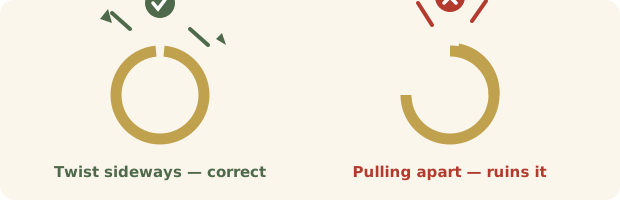
Small metal rings that connect everything else. The critical technique: never pull the ends apart. Grip each side with pliers and twist one end towards you and the other away, sideways. Pulling deforms the ring so it never closes cleanly again.
Strength depends on both gauge and diameter. An 18 gauge ring holds a heavy pendant; a 22 gauge one may quietly open in a handbag.
What gauge is that wire?
Our wire gauge identifier reads an unlabelled wire in AWG, British SWG and millimetres, with guidance on what each thickness will hold.
Crimp beads and crimp covers
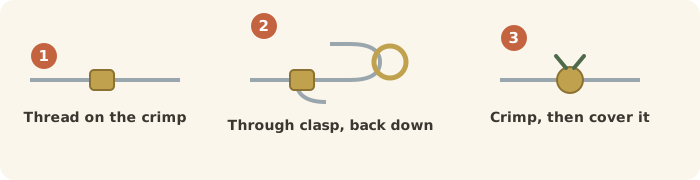
Crimps secure beading wire to a clasp. Thread the wire through the crimp, through the clasp loop, and back down through the crimp, then flatten it with crimping pliers rather than flat-nose ones — proper crimping pliers fold the crimp into a neat tube rather than squashing it, which is far stronger. A crimp cover then hides the whole thing and makes it look like a tiny bead.
Headpins and eyepins
Straight wires with a flat end or a loop, used for dangles and earrings. Thread a bead on, make a loop at the top, and attach. Wrapped loops take longer than simple ones but won't pull open — worth the extra minute on anything that will be worn regularly.
Buy quality for anything touching skin. Surgical steel, sterling silver or titanium for ear wires — cheap plated findings are the usual cause of irritated earlobes, and it's a poor way for a gift to be remembered.
Beading wire versus thread
Nylon-coated steel beading wire suits heavy or sharp-holed beads such as gemstones and crystals, which would cut through thread. Beading thread or elastic suits seed beads and stretch bracelets. Using thread with rough-holed gemstones is the reason many first necklaces break.
A sensible starter kit
Lobster clasps, jump rings in 18 and 20 gauge, crimps and crimp covers, headpins, plus three tools: round-nose pliers, chain-nose pliers and flush cutters. That covers the majority of projects, and everything else can wait until a specific piece demands it.
Questions we're often asked
How do I open a jump ring without ruining it?
Grip both sides with pliers and twist sideways — one end towards you, one away. Never pull the ends apart, which flattens the ring so it can't close neatly again.
What clasp is easiest for arthritic hands?
A magnetic clasp is easiest by far, followed by a toggle. Spring rings are the hardest and best avoided for anyone with limited dexterity.
Do I need special crimping pliers?
They make a noticeably stronger and neater join than flat pliers, folding the crimp rather than squashing it. They're inexpensive and worth having if you make necklaces regularly.