
Cast-On Methods: Which One and When
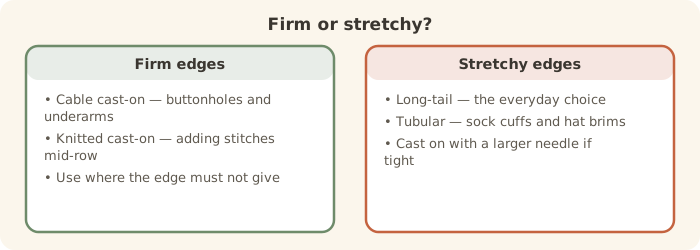
There are dozens of ways to get stitches onto a needle, and you need about four. Each behaves differently at the edge, and choosing the right one is the difference between a hem that sits flat and one that flares or strangles.
Long-tail cast-on — the everyday choice
Stretchy, tidy and quick once learned. It suits almost everything: jumper hems, scarves, blanket edges. The only fiddle is estimating the tail — allow roughly three times the width of your finished edge, or wrap the yarn around the needle once per stitch and add a little.
If you consistently run out of tail, cast on from both ends of the ball instead: work with the tail from the centre and the yarn from the outside, and you can never run short.
Knitted or cable cast-on — when you need to add stitches mid-row
Both work from an existing stitch rather than a tail, which makes them the answer for buttonholes, underarms and anywhere the pattern says "cast on 6 sts at the beginning of the next row". The cable version is firmer; the knitted version is softer and faster.
Tubular or stretchy cast-on — for ribbing that must give
Sock cuffs, hat brims and anything that has to stretch over a heel or a head. A long-tail cast-on worked with a larger needle gets you most of the way there; a proper tubular cast-on gives a beautiful rolled edge that looks machine-made.
How many stitches?
Before you cast on anything, you need the number. Our gauge calculator works it out from your swatch and the width you want, and rounds it to your stitch-pattern repeat so the ribbing comes out even.
Provisional cast-on — when you'll come back to it
Casts on with waste yarn so the stitches can be picked up live later. Used for shawls worked outwards from the centre, for hems folded and grafted, and for anything where both ends need to be worked. Fiddly the first time and straightforward thereafter.
If your cast-on edge is always too tight, use a needle one or two sizes larger for the cast-on row only, then switch back. This is more reliable than trying to cast on loosely, which tends to produce uneven stitches instead.
Matching the cast-off
A stretchy cast-on paired with a tight cast-off gives a garment that goes on but won't come off comfortably. If you've used a stretchy edge at the start, use a stretchy bind-off at the end — Jeny's surprisingly stretchy bind-off is the usual recommendation for ribbing and sock cuffs.
Questions we're often asked
How long should my long tail be?
About three times the width of the edge you're casting on, plus a few extra inches for security. For 100 stitches in DK, roughly a metre is safe.
Which cast-on is best for a scarf?
Long-tail for most scarves. If the scarf is in ribbing and you want the ends to match visually, a tubular cast-on paired with a tubular bind-off looks especially neat.
Why does my cast-on edge flare out?
Usually a cast-on that's too loose for the fabric, or a cast-on with more give than the stitch pattern that follows. Try casting on with your working needle size rather than a larger one.