
Beading Wire, Thread and Elastic: Which to Use
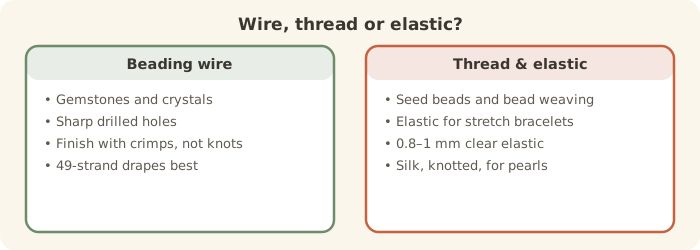
Beautiful beads on the wrong stringing material make a piece that breaks. Each type exists for a reason, and matching it to your beads is the most consequential decision in a beading project.
Beading wire
Nylon-coated stainless steel strands, sold by strand count — 7, 19 or 49. More strands means more flexibility and better drape, and 49-strand is worth the extra for anything that will be worn regularly.
Use it for gemstones, crystals and glass, whose drilled holes have sharp edges that will saw through thread over time. Finish with crimp beads rather than knots — wire doesn't knot reliably.
Will it fit through the hole?
Standard beads have holes around 0.8 to 1 mm; pearls and fine gemstones can be 0.3 to 0.5. Our bead sizer tells you the bead diameter, and our wire gauge tool tells you what your wire measures.
Beading thread
Nylon threads such as Nymo, or braided threads like Fireline. Used for seed bead work, bead weaving and anything needing many passes through the same bead.
Braided threads are considerably stronger and resist the cutting action of sharp beads, which is why bead weavers favour them. Condition nylon thread with beeswax or a thread conditioner to stop it tangling and fraying.
Elastic cord
For stretch bracelets that slip over the hand without a clasp. Use 0.8 or 1 mm clear elastic for standard beads — thinner than that and it snaps within months.
Three rules for elastic: pre-stretch it before stringing so the finished bracelet doesn't sag, tie a surgeon's knot followed by a second knot, and add a dab of clear jewellery glue before tucking the knot inside a bead. Skipping any of the three is why stretch bracelets end up scattered across a kitchen floor.
Silk for pearls, knotted between each one. The traditional method exists for two good reasons: pearls don't rub against each other, and if the strand ever breaks you lose one pearl rather than all of them. It takes far longer and it's worth it for anything valuable.
Leather and waxed cotton
For chunky beads with large holes, and for a rustic look. Neither is strong enough for heavy beads with small holes, and both stretch and degrade over time — fine for casual pieces, not for heirlooms.
Memory wire
Pre-coiled steel that holds a bracelet shape with no clasp. Convenient and forgiving of sizing, but it needs dedicated cutters — cutting it with ordinary jewellery cutters will ruin them permanently, which is a lesson most beaders learn once.
Questions we're often asked
What is the best cord for stretch bracelets?
Clear elastic of 0.8 or 1 mm for standard beads. Pre-stretch it, use a surgeon's knot with a second knot over it, and secure with a dab of jewellery glue.
Can I use thread with gemstone beads?
Not ordinary nylon thread — drilled gemstone holes have sharp edges that cut through it. Use nylon-coated beading wire or a braided thread designed to resist abrasion.
How long should I cut elastic cord?
Your finished length plus about three inches, which gives enough to hold while threading and to tie and hide the knot inside a bead.