
Amigurumi for Beginners: Hooks, Tension and Stuffing
Amigurumi — small crocheted toys and animals — follows different rules from every other kind of crochet, and that trips up experienced crocheters more than beginners. The main one: you want tight fabric, not comfortable fabric.
Go down a hook size, or two
The ball band suggests a hook for a nice drapey fabric. For amigurumi you want the opposite: dense fabric with no gaps for stuffing to poke through. With DK yarn, where the band says 4 mm, use 3 or 3.25 mm. The fabric should feel stiff and slightly unfriendly in your hands — that's correct.
Not sure what hook you're holding?
Amigurumi hooks are usually smaller than the ones in a standard set and lose their markings quickly. Our needle and hook sizer identifies an unmarked hook in seconds.
Work in continuous rounds
Most amigurumi is worked in a spiral rather than joined rounds, which avoids a visible seam line up the body. The consequence is that you lose your place easily, so put a stitch marker in the first stitch of each round and move it up as you go. Without it, counting becomes guesswork by round six.
The magic ring
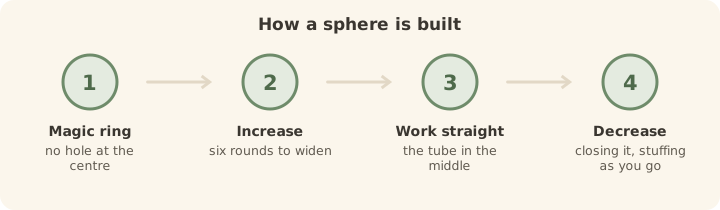
Starting with a magic ring rather than a chain gives a closed centre with no hole — which matters when the alternative is stuffing showing through the top of a head. It feels awkward the first three times and then becomes automatic.
Increases and decreases shape everything
Amigurumi shapes come from a simple rhythm: increase evenly to widen, work straight to make a tube, decrease evenly to close. A standard sphere is increases for six rounds, straight for six, then decreases for six. Understanding that pattern lets you design your own creatures rather than only following instructions.
Use invisible decreases — working through the front loops only — rather than standard ones, which leave visible bumps on a small piece.
Stuff firmly, and in small pieces. Add polyester filling a little at a time, pushing it into corners with the blunt end of a hook or a chopstick. Under-stuffed amigurumi looks sad and sags within days; over-stuffed stretches the fabric and shows gaps. Firm but still squeezable is the target.
Safety for children's toys
Safety eyes with washers are secure for older children but are not suitable for babies and toddlers, who can work them loose. For anything intended for a child under three, embroider the features with yarn instead. Use washable acrylic, and no ribbons or small removable parts.
Questions we're often asked
What hook size should I use for amigurumi?
One or two sizes smaller than the yarn band suggests. For DK yarn, try a 3 or 3.25 mm hook. The fabric should feel dense and firm, with no gaps for stuffing to escape through.
Why can stuffing be seen through my amigurumi?
The fabric is too loose. Go down a hook size and work more tightly. Lining the piece with a scrap of fabric before stuffing can rescue something already made.
Are safety eyes safe for babies?
Not for children under three. Embroider eyes with yarn instead — safety eyes are secure but not childproof, and small parts are a choking hazard.